Line 1: second generation biofuel
Columns for the number of gallons sold or used, the rate of $1.01, and the credit, which is column (a) x column (b).
6478
Biofuel Producer Credit
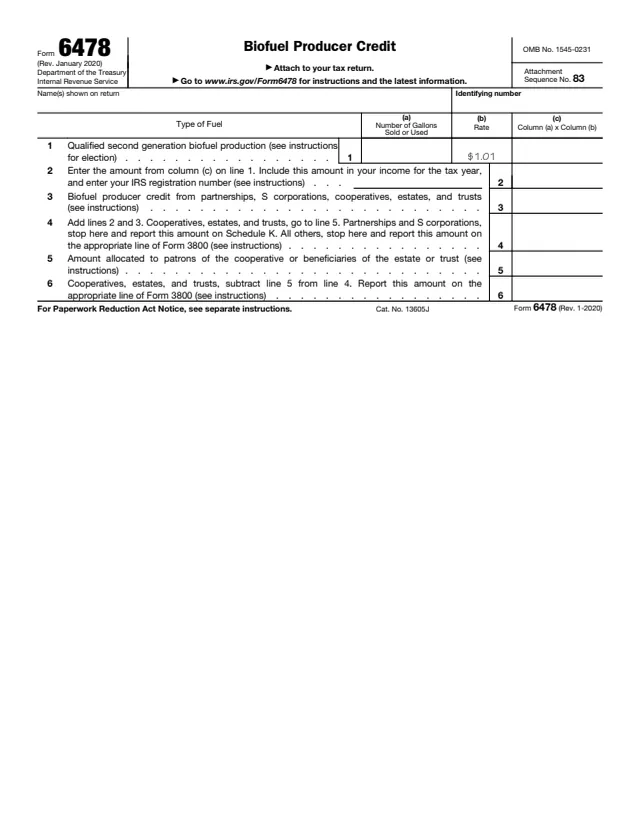
Form 6478 is used to figure the section 40 biofuel producer credit. The instructions say the credit is claimed for the tax year in which the sale or use occurs, and that it consists of the second generation biofuel producer credit. Line 1 of the form prints a rate of $1.01 per gallon of qualified second generation biofuel production.
The instructions (revised 10/2023) are for use with the January 2020 revision of the form, for tax years beginning after 2017. They say the credit is extended for fuel sold or used before 2025, and not to claim it for fuel sold or used after 2024 unless the credit is extended again. The IRS About page also lists a recent development titled "Completing Form 6478 for tax years beginning after 2024", dated 20-JAN-2026.
You can fill out the PDF free in your browser on this page and download the result without an account.
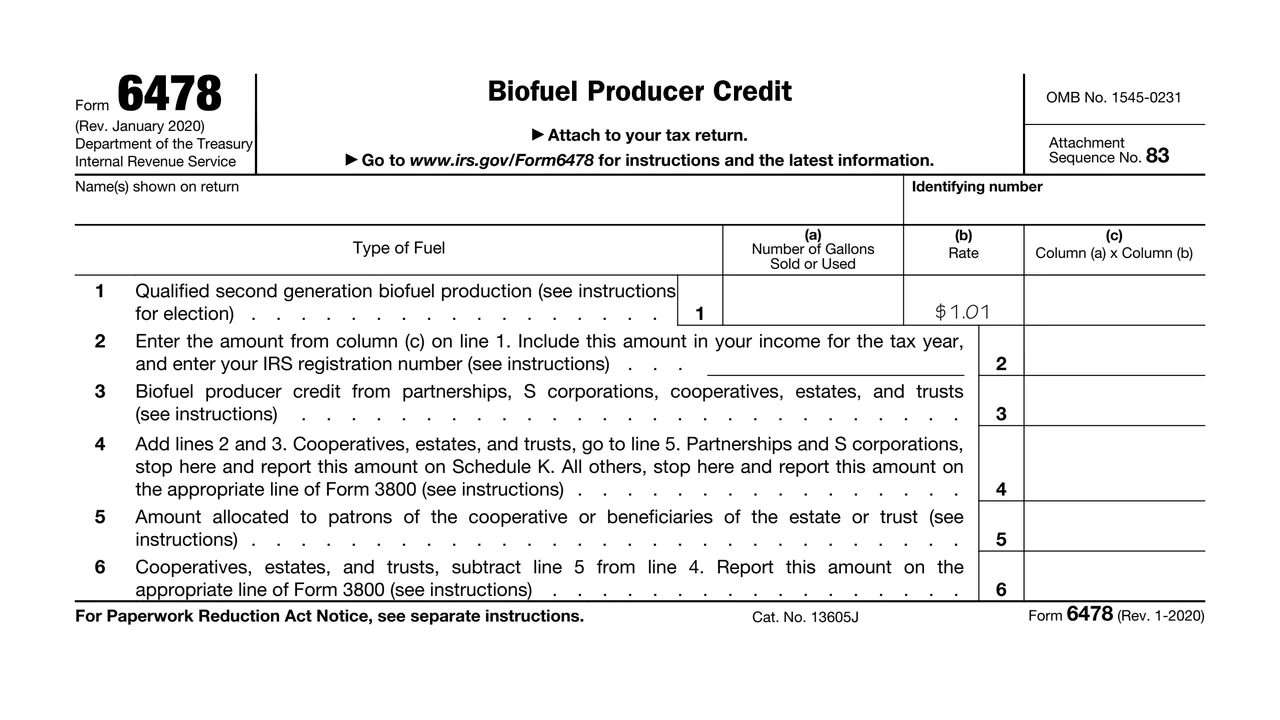
Columns for the number of gallons sold or used, the rate of $1.01, and the credit, which is column (a) x column (b).
The amount from column (c) on line 1, which the form says to include in income for the tax year, and the IRS registration number.
Biofuel producer credit received from partnerships, S corporations, cooperatives, estates and trusts.
Lines 2 and 3 added, with directions for where each type of filer reports the total.
For cooperatives, estates and trusts: the amount allocated to patrons or beneficiaries, and the remainder that goes on Form 3800.
Enter the gallons of second generation biofuel sold or used during the tax year that meet the conditions in the instructions, and multiply by the rate of $1.01 per gallon.
Enter the column (c) amount and the SB registration number. The instructions say this credit is included in income as other income on the return, and is subtracted for alternative minimum tax using Form 6251 or Schedule I (Form 1041).
Enter credits from Schedule K-1 (Form 1065) box 15 code l, Schedule K-1 (Form 1120-S) box 13 code l, Schedule K-1 (Form 1041) box 13 code H, and Form 1099-PATR box 12 or another notice of credit allocation.
Add lines 2 and 3. Partnerships and S corporations stop and report it on Schedule K. Cooperatives, estates and trusts go on to line 5. Everyone else reports it on Form 3800.
A cooperative may elect to allocate credit to patrons, and an estate or trust allocates it in the same proportion as income. Enter that share on line 5, subtract it from line 4, and report line 6 on Form 3800.
You get the real form, filled in a browser tab, with nothing standing between you and the finished PDF.
The form says to attach it to your tax return. The credit then flows to Form 3800, or to Schedule K for partnerships and S corporations.
The instructions say the credit may be claimed, or elected not to be claimed, within 3 years from the due date of the return (without extensions), on an original or amended return for the year of the sale or use.
The 10/2023 instructions say not to claim the credit for fuel sold or used after 2024 unless it is extended again. The About page lists a 20-JAN-2026 update on completing the form for tax years beginning after 2024.
If the fuel is not used for the purposes the instructions describe, a tax is due on each gallon at the rate used to figure the credit, reported on Form 720.
The election is made by completing line 5 on a timely filed return and notifying patrons in writing or on Form 1099-PATR. The instructions say it cannot be revoked once made.
3800
1,921 fields, 9 pages

637
50 fields, 7 pages
720
715 fields, 8 pages
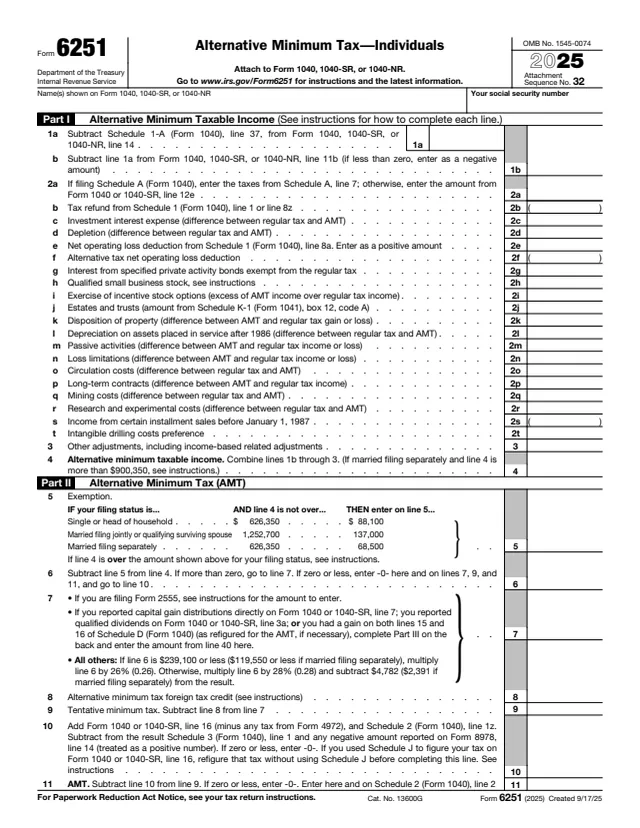
6251
62 fields, 2 pages
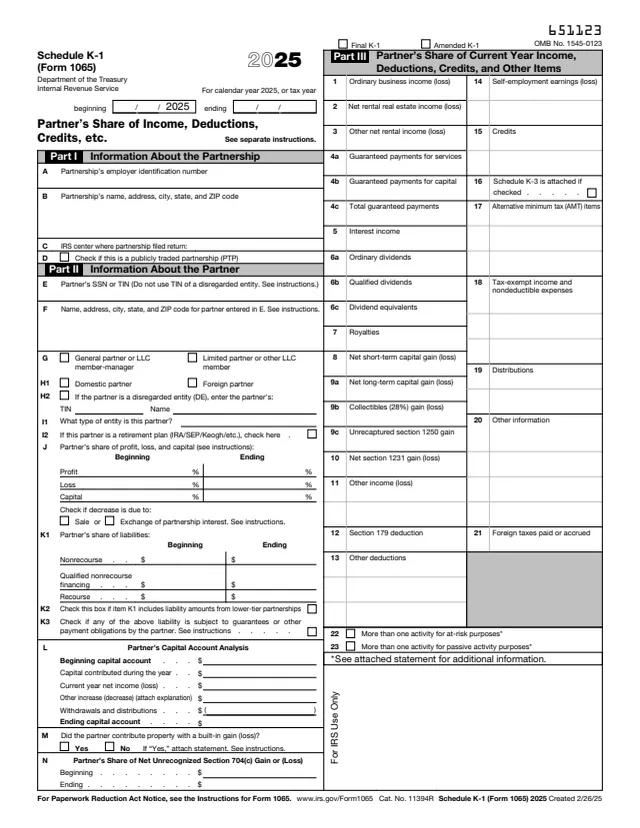
1065
111 fields, 1 page
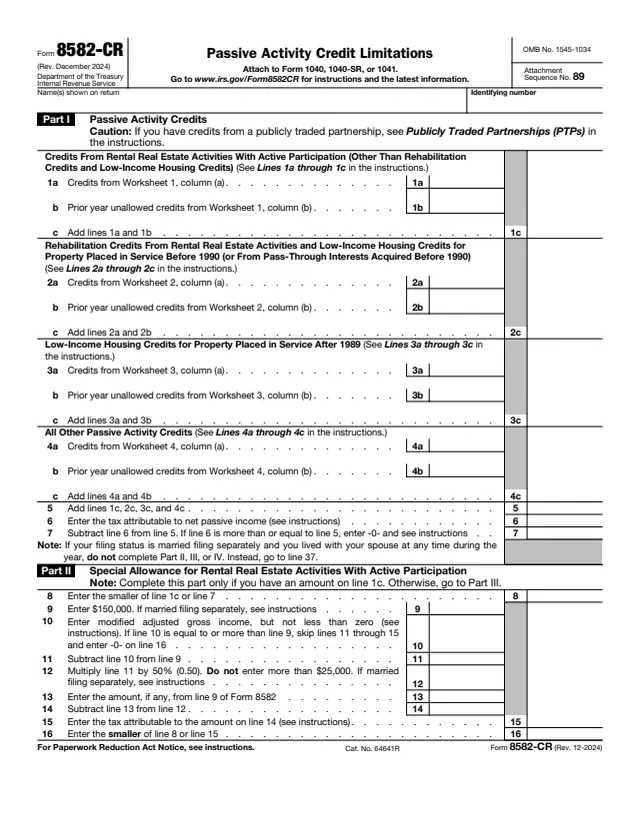
8582-CR
52 fields, 2 pages
The instructions say partnerships, S corporations, cooperatives, estates and trusts file this form to claim the credit. Other taxpayers may report a pass-through credit directly on Form 3800.
No tool matches that search.
The instructions describe it, generally, as liquid fuel derived from qualified feedstocks, such as lignocellulosic or hemicellulosic matter or cultivated algae, that meets EPA fuel registration requirements and is not alcohol of less than 150 proof.
Line 1 of the form prints a rate of $1.01 per gallon of qualified second generation biofuel production.
The instructions say taxpayers whose only source of the credit is a partnership, S corporation, cooperative, estate or trust are not required to file it, and report the credit directly on Form 3800.
The instructions say the line 1 credit is included in income as other income on the return, even if the tax liability limit keeps part of the credit from being used.
The 10/2023 instructions say not to claim it for fuel sold or used after 2024 unless the credit is extended again. The About page lists a January 2026 update about tax years beginning after 2024.
The instructions say all producers of second generation biofuel must be registered with the IRS, and point to Form 637, Application for Registration.