Part 1: Taxpayer Information (items 1 to 4)
The taxpayer's TIN, a box for multiple TINs, and the form and tax period the payment was intended for, if known. The form says not to enter the EIN of the taxpayer's bank.
13287
Bank Payment Problem Identification
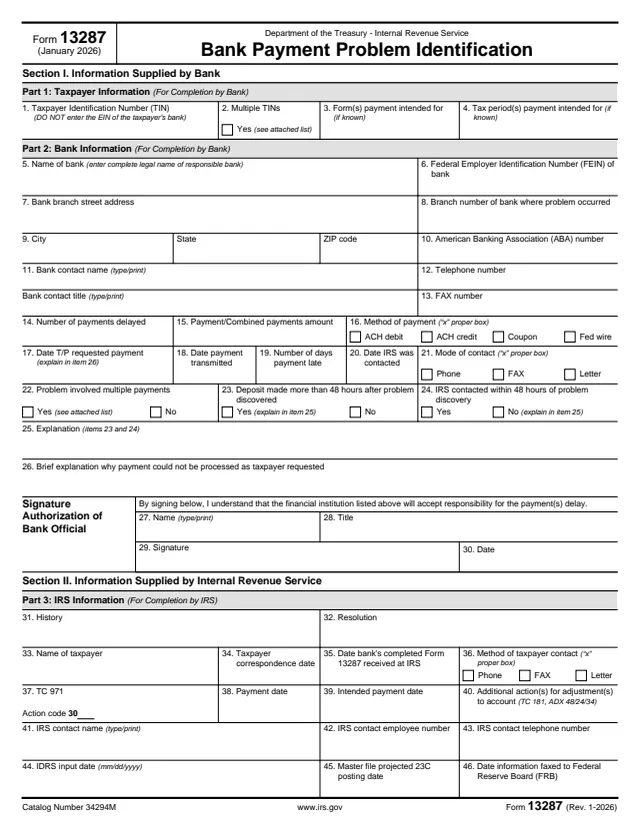
Form 13287, Bank Payment Problem Identification, documents a bank's delay in forwarding a taxpayer's Federal Tax Deposit (FTD) to the U.S. Treasury. The instructions printed on page 2 say that when a bank delays an FTD that was "timely received with proper instructions," the taxpayer may be relieved of the portion of the FTD penalty pertaining to that payment, if the bank accepts responsibility for the delay.
This is not a form an individual fills out and files. The instructions say the IRS faxes a separate Form 13287 and its instructions to the responsible bank for each delayed FTD payment or issue. The bank completes Section I and a bank official signs it. The IRS completes Section II. The signed form then becomes the authorization for the Federal Reserve Board (FRB) to charge the bank for the loss of funds to the U.S. Treasury.
You can fill out the PDF free in your browser on this page and download it without an account.
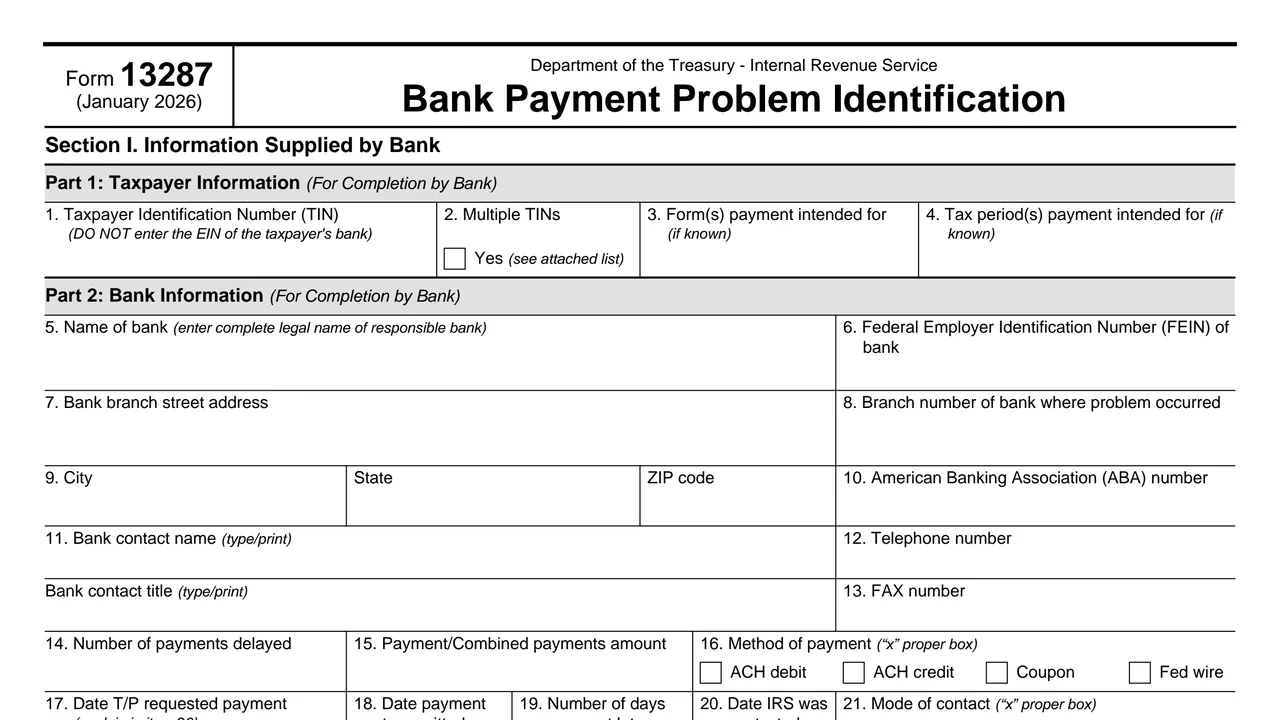
The taxpayer's TIN, a box for multiple TINs, and the form and tax period the payment was intended for, if known. The form says not to enter the EIN of the taxpayer's bank.
The bank's complete legal name, its FEIN, branch street address and branch number, American Banking Association (ABA) number, and a contact name, title, telephone and fax number.
Number of payments delayed, the amount, the method (ACH debit, ACH credit, Coupon or Fed wire), key dates, days late, how the IRS was contacted, and two 48-hour questions.
Item 25 explains the answers to items 23 and 24. Item 26 briefly explains why the payment could not be processed as the taxpayer requested.
Name, title, signature and date of the bank official who authorizes the bank's acceptance of responsibility for the delay.
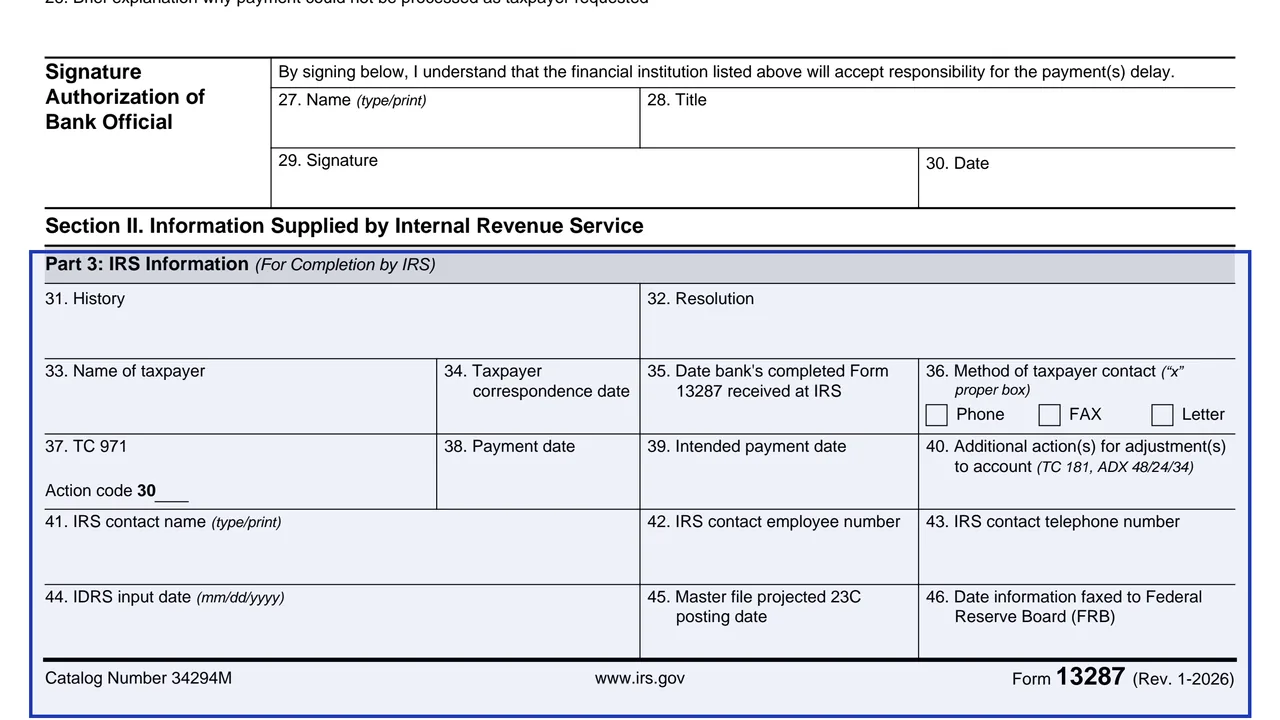
History, resolution, taxpayer name, contact dates, TC 971, payment and intended payment dates, IRS contact, IDRS input date and the date information was faxed to the FRB.
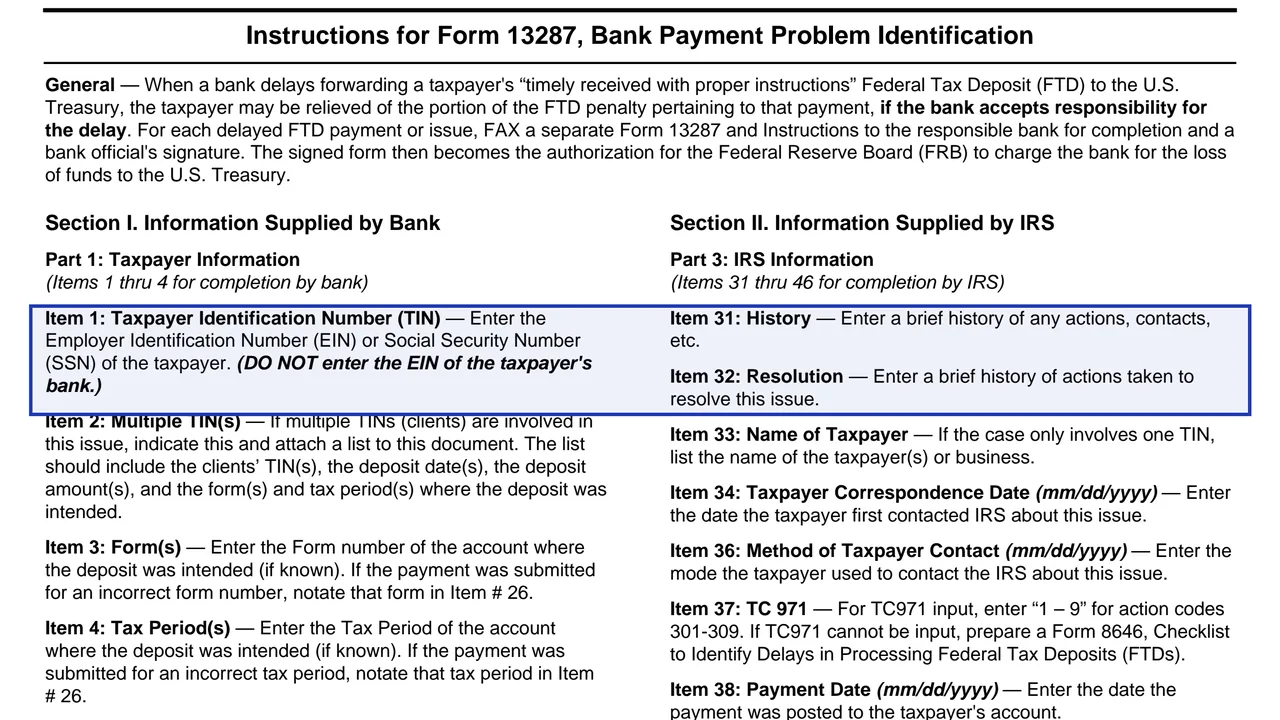
Enter the Employer Identification Number (EIN) or Social Security Number (SSN) of the taxpayer. The instructions say not to enter the EIN of the taxpayer's bank.
If multiple TINs (clients) are involved, indicate it and attach a list with the clients' TINs, deposit dates, deposit amounts, and the forms and tax periods where each deposit was intended.
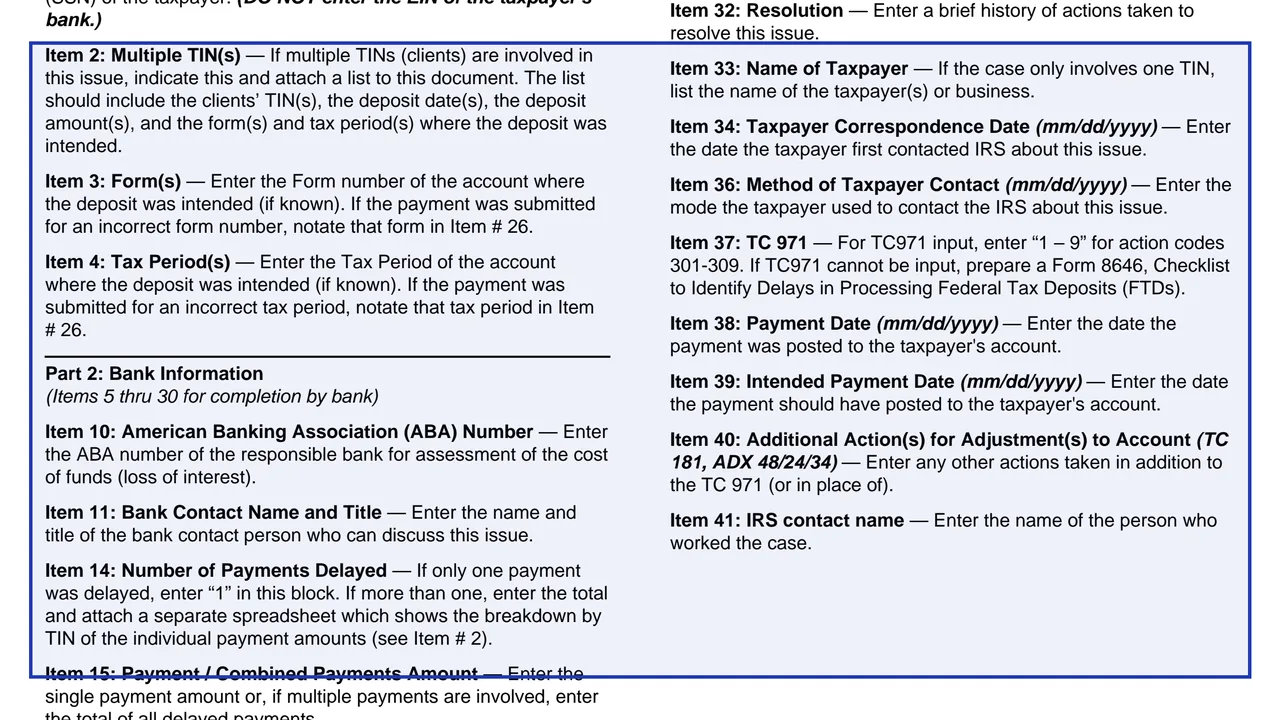
Enter the form number and tax period of the account where the deposit was intended, if known. If the payment was submitted for an incorrect form or period, note it in item 26.
Enter "1" if one payment was delayed. If more, enter the total and attach a spreadsheet breaking down the payment amounts by TIN. Item 15 is the single amount or the total of all delayed payments.
Enter the date the taxpayer requested the payment to post (the instructions say this usually is the due date), the number of days the payment was late, and the date the IRS was first contacted.
A bank official prints a name and title, signs and dates the form, accepting the bank's responsibility for the payment delay.
These steps follow the instructions printed on page 2 of the form.
You get the real form, filled in a browser tab, with nothing standing between you and the finished PDF.
The instructions say the IRS faxes a separate Form 13287 and instructions to the responsible bank for each delayed FTD payment or issue.
Item 35 records the date the bank's completed Form 13287 was received at the IRS. The form does not print a mailing address or fax number for the return.
The signed form becomes the authorization for the Federal Reserve Board to charge the bank for the loss of funds. Item 10, the ABA number, is used for assessment of the cost of funds (loss of interest).
Item 23 asks whether the deposit was made more than 48 hours after the problem was discovered, and item 24 whether the IRS was contacted within 48 hours. A Yes on 23 or a No on 24 is explained in item 25.
For item 37, the instructions say that if TC 971 cannot be input, the IRS prepares Form 8646, Checklist to Identify Delays in Processing Federal Tax Deposits (FTDs).
The form splits the work between the bank and the IRS. Items 1 through 30 are for completion by the bank, and items 31 through 46 are for completion by the IRS.
No tool matches that search.
No. The instructions say the IRS faxes the form to the responsible bank, the bank completes Section I and a bank official signs, and the IRS completes Section II.
The form says that by signing, the financial institution listed will accept responsibility for the payment delay. The signed form authorizes the Federal Reserve Board to charge the bank for the loss of funds.
The instructions say the taxpayer may be relieved of the portion of the FTD penalty pertaining to that payment, if the bank accepts responsibility for the delay.
Item 2 is checked and a list is attached showing the clients' TINs, deposit dates, amounts, and the forms and tax periods where the deposits were intended.
The taxpayer's EIN or SSN. The form and instructions both say not to enter the EIN of the taxpayer's bank.